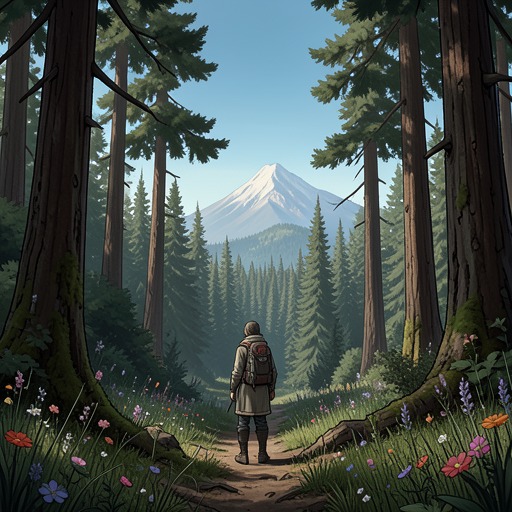
Elk Ridge
Happiness for BeginnersElk Ridge is a destination in the BCSC wilderness journey whose significance is shaped by sudden summer snowfall and the demands of navigating terrain without a visible trail. Beckett selected it as a more wind-sheltered place to camp after snow covered the group’s meadow, turning a planned short relocation into an all-day hike. The ridge represents both a practical response to uncertain weather and a landscape the hikers had to find by map, landmarks, and repeated checks rather than by following a clear path.
Setting and weather
The approach to Elk Ridge followed a night of heavy snowfall. By morning, snow weighed down the blue tarp over the group’s shelter, pressing it several feet lower than it had been set. Helen Carpenter kicked snow from its edge until the tarp rose enough for her to sit up. Outside the shelter, the meadow, wildflowers, and warm rocks where the group had spent the previous day were covered in white. The same place remained underfoot, but its familiar summer features had disappeared beneath the snow.
The weather left the group without a forecast or a dependable way to know what conditions would come next. They cooked breakfast and waited at camp while Beckett weighed two possibilities: remain where they were if snow continued, or descend to a lower elevation if the weather warmed. By noon the sky had cleared and the temperature had risen. Beckett then chose Elk Ridge for a short hike of three miles, valuing its better wind block in case temperatures dropped again. The decision was practical rather than confident: the group had to make its best estimate by watching the sky.
The hike to the ridge
Although the route was only three miles, the group spent the rest of the day reaching Elk Ridge. Snow had hidden the trail, and the difficulty lay less in its depth or physical resistance than in not knowing where the trail ran. Beckett stopped roughly every ten minutes to recheck the group’s position against landmarks. Before setting out, he had reviewed the route on a map with Helen and asked her to keep checking their position as they walked.
Conditions changed during the journey. Helen realized that the air was warming, and the snow began to give way to slush underfoot. This shift made the white landscape temporary even as it complicated travel: by the time the group arrived at Elk Ridge after an afternoon on the route, darkness had fallen and most of the snow’s earlier beauty had vanished. The ridge was thus reached not in the stillness of a lasting winter scene, but at the end of a slow passage through rapidly changing conditions.
The ridge and the Solo sequence
The book later connects Elk Ridge with the final week of the wilderness trip, when Beckett prepares the participants for the Solos: twenty-four hours of surviving on their own in separate groups. In the subsequent Solo sequence, a campsite is surrounded by flattened oval patches of grass, evidence that large animals had rested nearby overnight. By morning the animals are gone. The scene makes the landscape active beyond the hikers’ plans: the group reads signs left in the grass, but the animals themselves remain unseen.
On the second day, Dosie and Jake choose Helen as their leader for the return hike, and she leads the group back along the trail. A map held the right way up helps; so does her unusually confident map-reading, which she keeps to herself. The group stays together and on the trail. Its only serious difficulty comes at the start, when everyone must cross a rickety bridge. The bridge creaks and sways, and Jake has more trouble than the others because of his duct-taped glasses. All make it safely across, and Helen’s group is the first to return to Beckett.
Narrative significance
Elk Ridge belongs to a stretch of the journey in which orientation depends on attention rather than certainty. Snow erases the trail, warmth changes snow to slush, and a map must be checked against landmarks as the route unfolds. Later, the signs of animals at the campsite offer another kind of reading: the group can infer that large beasts were close, although it cannot see them. The setting therefore tests practical judgment while resisting complete human control or knowledge.
The movement toward Elk Ridge also contrasts the sudden transformation of the meadow with the work of getting somewhere safely afterward. The snowfall first makes the familiar landscape seem wholly changed; the hike then turns that spectacle into a navigation problem, and the thaw makes even the spectacle short-lived. In the Solo return, Helen’s leadership and successful route-finding provide a quieter counterpoint: the same wilderness that obscures paths also gives her an occasion to use a skill she describes as nearly useless in ordinary life.